

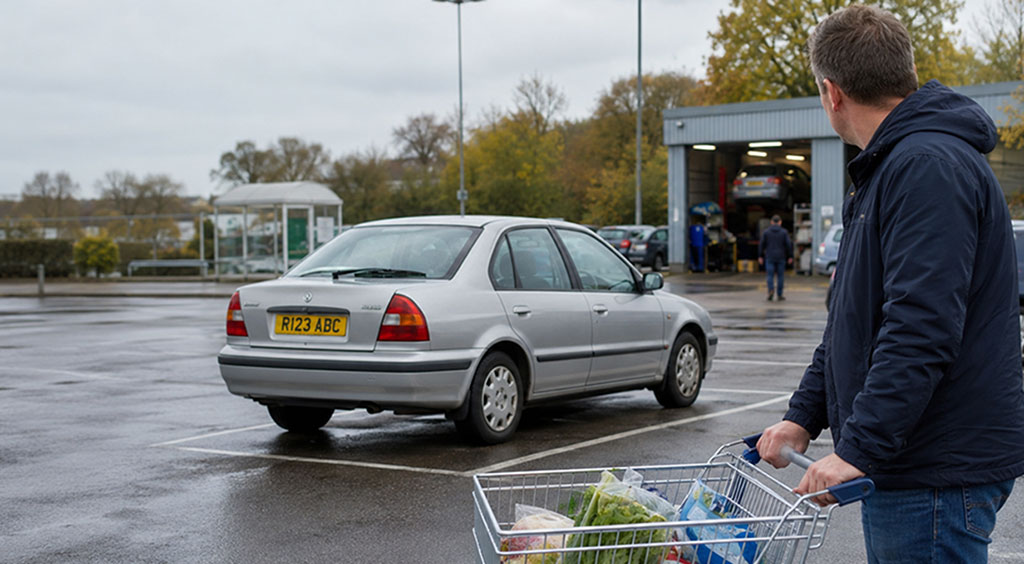
Imagine this.
Your old vehicle has finally reached the point where repairs no longer make sense. Maybe the MOT bill was too high. Maybe it had a fault that wasn’t worth chasing. Maybe you just needed it gone.
So you “scrap” it.
Then, a few weeks later, you see what looks suspiciously like the same vehicle parked outside Tesco.
Same colour. Same model. Maybe even the same little dent you remember.
So what’s going on?
Has something dodgy happened?
Possibly. But not necessarily.
Because here’s the bit many people don’t realise:
Scrapped doesn’t always mean crushed.
Getting rid of a vehicle is not always the same as destroying it
When most of us say a vehicle has been scrapped, we usually mean: “I got rid of it because it wasn’t worth keeping.”
But that does not always mean it was immediately crushed, shredded, melted down, or turned into a washing machine.
Sometimes a vehicle really is at the end of its life. It may be stripped for parts, safely recycled, and officially destroyed.
But sometimes, the vehicle still has value. A trader, dismantler, scrapyard, online car buying service, repairer or authorised treatment facility may decide it is worth fixing, breaking for parts, or selling on.
So yes, in some cases, a vehicle you thought had gone forever could end up back on the road.
That might feel odd. But it is not automatically suspicious.
Why would anyone repair a vehicle you thought was finished?
Because “not worth repairing” depends on who is doing the repair.
To you, the vehicle might not make sense any more. A garage quote might be too high. The MOT work might cost more than the vehicle feels worth. Or maybe you simply do not want the hassle.
But someone else may see it differently.
- They may have cheaper access to parts.
- They may do the labour themselves.
- They may only want the engine, gearbox, panels, wheels, interior, lights or electronics.
- They may be able to repair and sell it for a profit.
So when you “scrap” a vehicle, you are not always paying for it to be destroyed.
Sometimes you are simply passing it on to someone else, who then decides what happens next.
The bit that matters to you
For most owners, the real question is not:
“What happened to my old vehicle?”
The real question is:
“Am I still responsible for it?”
That depends on whether you told DVLA correctly when the vehicle left you.
And this is where it helps to separate two situations.
If you sell it to a private person
If you sell the vehicle to a private person, you have not scrapped it.
You have sold it.
In that situation, you should give the new keeper the green “new keeper” section from the V5C log book, but keep the rest of the V5C so you can tell DVLA that you have sold the vehicle.
You can usually do this online, or by post using the V5C.
The important thing is to do it straight away.
- Do not wait for the buyer to sort it.
- Do not assume it will happen automatically.
- Do not leave it until later.
Once DVLA has been told, the vehicle record can be updated and you are no longer shown as the registered keeper.
If it goes to a trader, dismantler, insurer, scrapyard or recycling centre
This is the situation many people describe as “scrapping” a vehicle.
- You might have used an online scrap comparison website.
- You might have sold it to a breaker.
- You might have taken it to an authorised treatment facility.
- You might have handed it to a trader who collects non-running vehicles.
All of those can be perfectly legitimate.
But the paperwork is different from a private sale.
If the vehicle goes to the motor trade, an insurer, a dismantler, a scrapyard or an authorised treatment facility, you should use the yellow section of the V5C, or the online DVLA service, to tell DVLA straight away.
Do not give the yellow section away with the rest of the log book. That yellow section is there to help you tell DVLA that the vehicle has gone to the motor trade, insurer or dismantler.
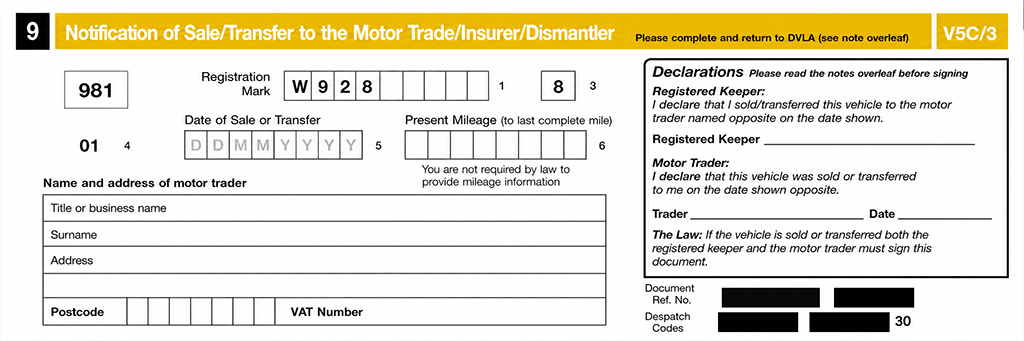
The simple rule is:
Give the vehicle and the rest of the V5C to the trader, dismantler, insurer or ATF. Keep the yellow section and tell DVLA straight away.
That is the bit that helps protect you.
Don’t wait to find out what they do with it
This is the part that catches people out.
You may think the vehicle is going to be destroyed. The person collecting it may even talk about “scrapping” it.
But you may not know exactly what happens next.
- They might destroy it.
- They might repair it.
- They might sell it on.
- They might break it for parts.
- They might pass it to another business.
That is why you should not wait to see what happens.
Your job is not to manage the vehicle’s future. Your job is to make sure DVLA knows it has left your hands.
So if it has gone to a trader, dismantler, insurer, scrapyard or ATF, tell DVLA straight away using the yellow section or the online service.
Do not rely on anyone else to do it for you.
What about the Certificate of Destruction?
If an authorised treatment facility actually destroys the vehicle, they should issue a Certificate of Destruction to you within 7 days. That certificate is proof that the vehicle has been destroyed through the proper process.
But you should not wait for a Certificate of Destruction before telling DVLA the vehicle has left you.
And not receiving one is not automatically a problem.
It may simply mean the vehicle was not destroyed. The ATF or trader may have decided to repair it, sell it on, or use it for parts instead.
That is why the most important step is still the one you control:
Tell DVLA straight away when the vehicle leaves you.
If the vehicle is later destroyed, the Certificate of Destruction is extra confirmation of what happened to it.
If it is not destroyed, you may not receive one – but that does not automatically mean something has gone wrong, as long as you told DVLA properly and kept your confirmation.
So if you see your old vehicle again…
First, do not panic. It may have been repaired and sold on legitimately.
Or, if it really was supposed to be destroyed, as long as you told the DVLA, then it’s simply not your problem.
The simple rule is this:
Scrapped does not always mean crushed. But when the vehicle leaves you, make sure DVLA knows.
If you have received the Certificate of destruction, and you then see it on the road, that’s when something iffy has gone on. But the same rule applies, as long as you told the DVLA, then it’s not on you.
Because once that bit is right, what happens next is much less worrying.