

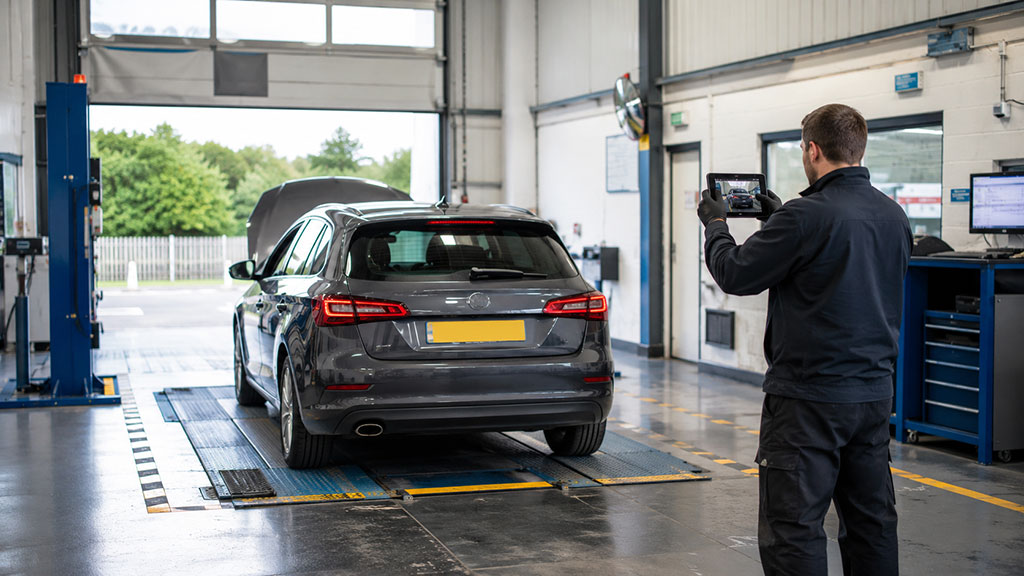
There’s a new addition coming to MOT tests across Great Britain. Your vehicle may now have its photograph taken while it’s being tested.
It isn’t for your MOT certificate, and you probably won’t ever see the photograph yourself. Instead, it’s part of a DVSA crackdown on a surprisingly common type of fraud known as a “ghost MOT”.
From 3 August 2026, the DVSA began rolling out its new Photos at Test system to around 2,500 MOT garages. Testers at participating sites can take a photograph of the whole vehicle in the testing bay and upload it directly to the MOT testing system.
It sounds like a small change, but it’s designed to make it considerably harder to issue an MOT certificate for a vehicle that was never actually there.
What exactly is a ghost MOT?
A ghost MOT happens when an MOT pass is entered onto the official system even though the vehicle hasn’t genuinely undergone the test.
In the most blatant cases, the vehicle never even enters the MOT station.
And although MOT fraud represents only a small proportion of the millions of legitimate tests carried out every year, ghost MOTs are a particular concern. The DVSA says they account for nearly 80% of fraudulent MOTs.
That immediately raises an obvious question.
So why would anyone do it? Usually, it comes down to money. A vehicle that should fail may need expensive repairs before it can legally pass, while a valid MOT also makes it much easier to sell. For a rogue tester, there can also be money to be made by accepting payment to issue the pass without properly testing the vehicle.
How does taking a photograph help?
The principle is remarkably simple.
During the MOT, the tester can photograph the vehicle while it is in the testing area. The image is then uploaded directly into the MOT testing service.
It provides another piece of evidence linking three things together:
the vehicle, the MOT garage and the test taking place at that time.
That makes it considerably harder for a tester to sit at a computer and record a pass against a registration number for a vehicle that might be miles away.
The DVSA has already been using other technology to detect exactly this type of behaviour.
For example, it can compare MOT records with Automatic Number Plate Recognition (ANPR) information to investigate whether a vehicle was actually in the vicinity of the garage when its supposed MOT took place.
Adding a photograph gives investigators another way of confirming that the vehicle being recorded was genuinely present.
Does every MOT now involve a photograph?
No.
The scheme is currently being rolled out rather than introduced across every MOT station at once.
Around 2,500 garages are included in this phase and, at present, taking the photograph is not compulsory. Participating testers can record why a photograph hasn’t been taken and continue with the MOT.
So if your vehicle goes for its MOT and nobody takes a picture, that doesn’t mean anything is wrong with the test.
The DVSA is encouraging participating garages to use the system so testers become familiar with it, and photography could eventually become a more established part of the MOT process.
Does this mean MOT histories can’t be trusted?
No, and it’s important to keep the issue in perspective.
The overwhelming majority of MOT tests are carried out properly. In previous enforcement information, the DVSA has described fraudulent testing as involving only a small proportion of garages and testers.
Your vehicle’s MOT history therefore remains an extremely useful record.
Looking through it can tell you when a vehicle was tested, whether it passed or failed, its recorded mileage and what defects or advisories were found.
Over several years, that can build up a surprisingly detailed picture of a vehicle’s life.
The new photograph system should ultimately make that information more robust, not less useful.
It’s another step towards making sure the vehicle represented by an MOT record really was the vehicle sitting in the test bay.
Particularly useful when buying a vehicle
MOT history becomes even more valuable when you’re considering buying a used vehicle.
Rather than simply checking whether it currently has an MOT, it’s worth looking back through the complete history.
Repeated advisories, previous failures and changes in recorded mileage can all tell you something about the vehicle you’re considering.
But an MOT shouldn’t be confused with a complete vehicle history check.
An MOT is primarily an inspection of whether specific safety and environmental components met the required standard at the time of the test. It doesn’t tell you everything about a vehicle’s past.
For example, there are other questions you may want answering before handing over your money, such as whether the vehicle has previously been written off, recorded as stolen, has outstanding finance or has other important history attached to it.
That’s why, as always, we’d recommend carrying out a full vehicle history check before buying a used vehicle, alongside reviewing its MOT and mileage history.
Together, those different sources of information can give you a much clearer picture of what you’re actually buying.
A small photograph with a bigger purpose
Most motorists probably won’t notice much difference as the new system is introduced.
Your MOT should take roughly the same form as before, and you may never see the photograph that’s taken.
But that’s rather the point.
This isn’t really a new feature for motorists. It’s another layer of protection behind the information we already rely upon.
Every legitimate MOT contributes to the history of a vehicle, and that history can remain associated with it for many years and through several different owners.
If a quick photograph makes it harder for somebody to add a test to that history without the vehicle ever appearing at the garage, it seems like a worthwhile addition.
One thought on “Why your vehicle may soon be photographed during its MOT”
Leave a Reply
You must be logged in to post a comment.
Great idea should have been implemented years ago, But the photo i think should be on the M.O.T certificate to show that it is the car the certificate applies to.